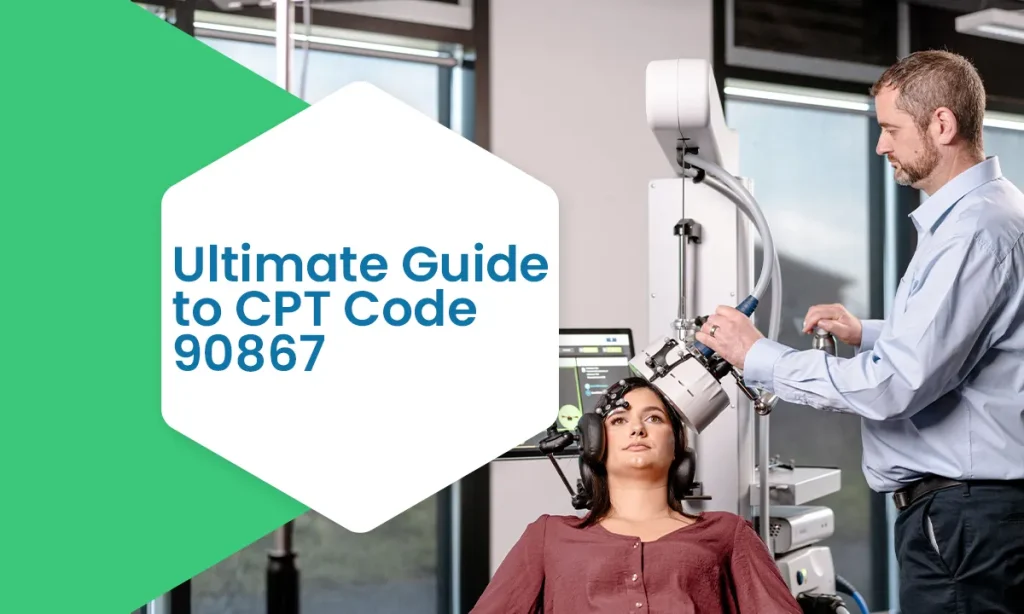
Did you know that the success rate for transcranial magnetic stimulation (TMS) therapy ranges from 70 to 80%?
However, TMS providers often struggle with claims denials for these critical therapy sessions. This guide explores the common causes leading to denials.
What’s more? We will provide an overview of the primary TMS CPT codes and share the best practices to streamline your billing workflow.
So, continue reading!
TMS CPT Codes
The table below offers an at-a-glance view of the three primary CPT codes for TMS therapy:
| TMS Billing Codes | Description |
|---|---|
| 90867 | It covers the initial therapeutic TMS session. That is, it includes the initial cortical mapping, motor threshold determination, and delivery. |
| 90868 | It covers the subsequent therapeutic TMS sessions. That is, it includes the ongoing delivery and management for each subsequent treatment session. |
| 90869 | It is used when a provider must recalculate a patient’s motor threshold during a subsequent TMS session. It includes both the redetermination of electrical pulse intensity and treatment delivery. |
Common Reasons for TMS Claim Denials
Discussed below are some of the common reasons behind claim denials for transcranial magnetic stimulation CPT codes:
Pre-Authorization Errors
It is one of the major reasons why a claim with a TMS CPT code is denied. Let’s consider a few examples:
- You acquired payer approval to render the service, but performed the therapy outside the approved date range. The result? Claim denial because you missed the approved pre-authorization deadline.
- Missing the pre-authorization number on the claim form altogether can also trigger a denial.
Session Tracking & Sequencing Errors
Do you know that insurance carriers closely monitor the chronological progression of daily treatments? Errors include documenting duplicate session numbers, skipping chronological sequences, or entering incorrect service dates.
All these documentation errors can trigger automated denials on your claims with TMS billing codes.
Lack of Medical Necessity
Establishing medical necessity is the key requirement set by all insurance carriers. This means payers require extensive, structured evidence in the physician’s chart notes demonstrating the medical necessity of the rendered TMS therapy.
In case you fail to document a clear history of treatment-resistant depression, it will lead to medical necessity denials.
Unapproved Same-Day E/M Billing
What happens when you attempt to bill a standard evaluation and management (E/M) office visit on the same day as a routine CPT code for TMS therapy?
You receive a denial unless your documentation contains a completely separate, significant medical issue with relevant modifiers.
Exceeding Therapy Limits
Most insurance carriers have a strict lifetime or annual cap on the total number of acute TMS sessions. Typical limits set by most payers are 36 sessions over a 6-week course.
In case you exceed this baseline unit limit without an active, secondary clinical authorization, it causes denials.
Coding Errors
What happens when you submit a remapping CPT code for transcranial magnetic stimulation, i.e., without documenting the precise physical shift in a patient’s motor threshold? It triggers a denial.
Best Practices to Minimize TMS Claim Denials
The following are some of the best practices to ensure a seamless revenue cycle against your billed TMS CPT codes:
Implement a Pre-Authorization Workflow
Avoid scheduling the first mapping sessions until you have a valid and active prior authorization number.
You can achieve it by:
- Cross-referencing the approved date range.
- Ensuring the total sessions are under the allowable frequency.
- Verifying if a third-party behavioral health vendor handles the network carve-out.
Audit Physician Charts
Verify that the physician’s intake notes document at least 2 to 4 failed antidepressant trials from different drug classes. That is not all; your documentation should also include a history of minimal response to evidence-based psychotherapy.
Proactively Track Sequential Session
Utilize an EMR/EHR system that hard-codes sequential counts. This will help you prevent automated duplicate denials for TMS billing codes.
Isolate Same Day E/M Encounters
The best practice is to avoid billing regular E/M office codes alongside routine daily CPT codes for TMS.
But what happens when a psychiatric evaluation is absolutely necessary for an unrelated crisis? Then you should document it comprehensively and append modifier 25 to prevent denials.
Document Explicit Triggers for Remapping
You should only bill a remapping session if the chart notes clearly substantiate a physiological reason for a threshold shift.
Some of the factors that you must not neglect while documenting include the following:
- Introduction of a new medication
- Significant weight fluctuations
- Specific side effects that necessitated a manual motor-threshold recalculation
Streamline TMS Billing with MediBillMD
To summarize, there are three primary TMS CPT codes. These include
(initial therapeutic TMS session), 90868 (subsequent therapeutic TMS sessions), and 90869 (motor threshold recalculation during a subsequent TMS session).
In case you are having trouble collecting timely reimbursements for these therapy codes, consider acquiring TMS billing services from professionals like MediBillMD. We offer tailored specialty-specific solutions with a dedicated account manager and around-the-clock support. Besides, we have a track record of guaranteeing a 98% clean claim rate and a 96% collection ratio.
FREQUENTLY ASKED QUESTIONS