

Modifiers help you provide additional details while billing for your service. Coding specificity ensures you receive rightful reimbursements every time. Some modifiers help you alert the payer that a procedure took more time, effort, and resources than a typical procedure. Thus, it is eligible for higher reimbursement. Others enable you to provide additional information about a performed procedure and the nature of the service.
This guide will cover everything you need to know about modifier 26, from applicable scenarios to usage guidelines. So, if you are interested in understanding when you should append it and when you should skip it, we advise you to read this guide till the end!
Modifier 26 – Description
Some procedures in the CPT coding system are a combination of technical and professional components. These procedures typically belong to diagnostic testing, such as CT scans, ECG, and ultrasounds.
Thus, if a physician performs only the professional component (PC) of such a procedure, a modifier 26 will be appended to alert the payer of the specific nature of the service. For the unversed, the physician’s service of interpretation, supervision, and generating a report is referred to as a professional component.
Modifier 26 – Examples
Below are a few examples where you may apply this professional component or PC modifier.
Unattended Sleep Study
Let’s consider a scenario where a patient undergoes a home sleep study test. The patient uses a portable device to record the sleep pattern himself. Contrarily, the sleep specialist will be responsible for analyzing the recorded data, interpreting results, and generating a report.
Thus, the healthcare practitioner would report CPT code 95806 with modifier 26. It will inform the insurance payer that the provider is only billing for the professional component of the sleep study.
ECG Interpretation
Assume a patient experiencing shortness of breath and chest pain, meeting a cardiologist. Thus, recognizing the urgency, the provider orders an electrocardiogram (ECG) to assess the patient’s health.
A technician performs the technical aspects of ECG while the cardiologist interprets the results and generates a report after reviewing the heart rate, rhythm, and any signs of abnormalities.
Here, the cardiologist will report the CPT code 93000 with modifier 26 to ensure rightful reimbursement from the payer.
Ultrasound Interpretation
A patient was concerned about a lump in the thyroid gland. Thus, the primary care physician referred to visit an endocrinologist, who ordered an ultrasound to assess the nature of the lump.
The sonographer performed the ultrasound and captured the images of the thyroid gland, while the endocrinologist reviewed it and suggested the next course of action based on the findings.
Since the endocrinologist only interpreted the images, the claim will include the 76536 CPT code appended with modifier 26 to highlight the professional component of the procedure.
Accurate Usage Guidelines for Modifier 26
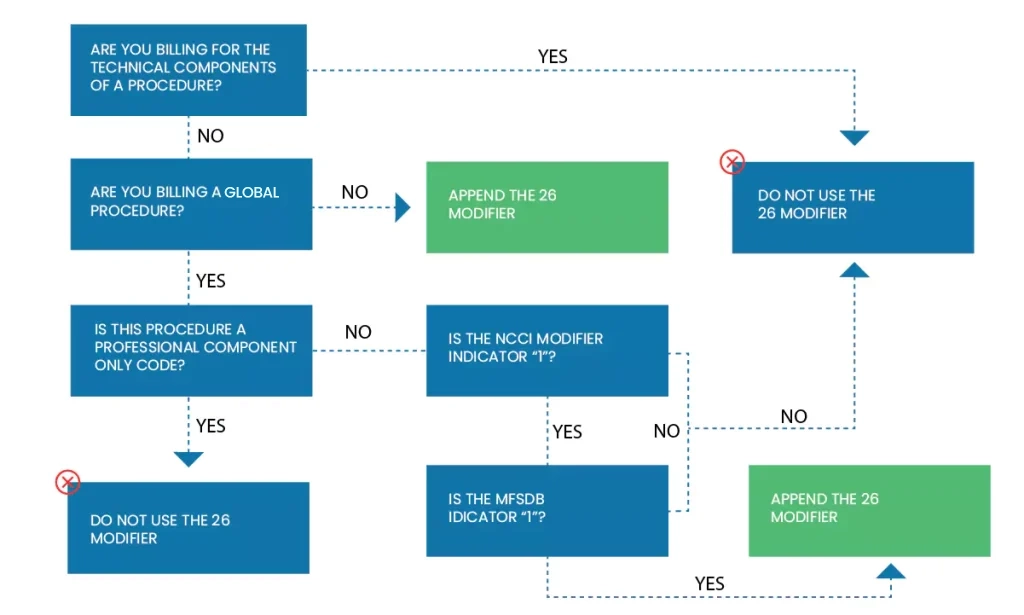
Discussed below are a few rules that you should consider when deciding whether or not to append modifier 26 with a CPT code to accurately bill for your rendered care services.
Rule # 1
You should append modifier 26 with the procedural code when the clinician performs the professional component of a global procedure, i.e., conducts interpretation and generates a report but does not perform the procedure.
Rule # 2
You can only append this modifier with CPT codes listed in the CMS national physician fee schedule and relative value files (NPFSRVF) as modifier 26-appropriate.
Rule # 3
Do not append this modifier to global-test-only procedures.
Rule # 4
Avoid using this modifier for professional component-only procedures.
Rule # 5
Do not add this modifier to technical component-only procedures.
Rule # 7
Modifier 26 should not be appended if a practice or institution owns the equipment, purchases the supplies for performing the technical components of the test, and employs the technologist and physician responsible for technical and professional components of the procedure, respectively.
Summary
We covered most aspects of modifier 26, including some practical scenarios where you may apply it to ensure accurate reimbursements. We also discussed some significant rules you must consider while deciding whether or not to use it with a particular procedural code. However, if you still have a question, check out our FAQ section below to find responses to your concerns. Besides, if you have challenges understanding the complex concept of modifiers in the already intricate coding system, we suggest you outsource medical billing workflow to professionals like MediBillMD.
Frequently Asked Questions