

Did you know that gross and net collection rates are integral revenue key performance indicators (KPIs) that every medical practice should track and monitor? That is not all; according to the American Academy of Family Physicians (AAFP), the net collection ratio (adjusted collection rate) should ideally not fall below 95%.
With that said, many of you may get confused about what makes net and gross collection ratios distinct from one another. Worry not, because this guide will help you clear the fog.
It covers the formula, example calculation, and industry benchmarks for both metrics. Besides, it discusses the common reasons behind a low net rate and best practices to improve it. So, continue reading!
Gross Collection Rate in Medical Billing
Gross collection ratio or rate (GCR) helps you calculate the total billed charges for medical services before applying any adjustments. Simply put, gross shows what you charge.
Formula
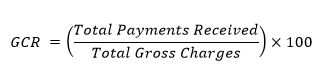
Example Calculation
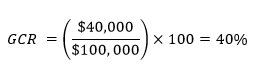
Let’s consider a practice with the following billing cycle metrics:
- Total gross charges = $100,000
- Total actual payments (insurance + patient) = $40,000
- Contractual adjustments (insurance discounts) = $55,000
Now, using the formula, we get GCR, i.e, 40%,
Industry Benchmark
The table below offers an at-a-glance view of the industry benchmark for gross collection ratio:
| GCR Range | Performance Status | What Does It Entail? |
|---|---|---|
| Below 30% | Underperforming practice | It means significant revenue loss, a huge amount of uncollected patient bad debt, or an excessively inflated fee schedule. |
| 30% to 50% | Healthy revenue cycle | It indicates your master fees are set appropriately high enough to capture the maximum allowed reimbursement from every insurance carrier. |
| Above 60% | Potentially underpriced services | A very high gross rate often indicates revenue leakage because your baseline fees are set too low. That is, some payers might be willing to pay more than what you are charging them. |
Net Collection Rate in Medical Billing
Net collection ratio or rate (NCR) is a key metric that helps practices measure the effectiveness of reimbursement dollars on the agreed-upon fees charged. Besides, it offers a clear picture of your revenue cycle and financial performance. How?
When you monitor the net rate, it reveals how much revenue is lost due to factors such as missed filing limits, uncollectible bad debt, high denial rates, other non-contractual adjustments, and poor patient collections.
Formula

Example Calculation
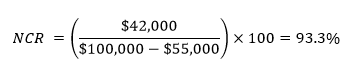
Let’s assume a practice whose typical billing cycle looks like this:
- Total gross charges = $100,000
- Total payments received = $42,000
- Contractual adjustments (insurance write-offs) = $55,000
- Non-contractual adjustments (preventable write-offs) = $1,000
Now, by applying the formula, we get 93.3% NCR,
Industry Benchmark
The following table offers an at-a-glance view of the industry benchmark for net collection ratio:
| NCR Range | Performance Status | What Does It Entail? |
|---|---|---|
| Below 90% | Critical danger zone | It signifies a billing crisis. That is, the practice is losing at least 10% of its earned income to preventable issues. These include credentialing lag, unworked denials, or bad patient debt. |
| 90%+ | Average | Even though acceptable, it indicates that money is quietly slipping through the cracks due to neglected claim denials or poor front-desk collection workflows. |
| 95% to 98% | Industry ideal | It highlights a high clean claim rate, low denial rate, and proactive patient collections. |
Common Reasons for a Low Net Collection Rate
Discussed below are some of the primary causes of a low NCR:
High Denial Rate
Did you know that the industry average for a claim denial rate is between 5% and 10%? Besides, it is also a common reason for a low net collection ratio.
Let’s review what happens behind the scenes!
If payers deny a medical claim and your billing team fails to appeal or correct it within the timely filing window, that money is permanently lost. Some of the common culprits for denials are:
- Failure to secure payer approval (pre-authorization) before performing expensive or elective procedures.
- Missing or incorrect patient details. Even simple front-desk mistakes, such as misspelled policy numbers, can also result in a denial.
Coding Errors
Inaccuracies in code selection are another major reason behind a low NCR. These include:
- Intentionally or accidentally mismatched levels of service compared to clinical documentation. That is, upcoding or downcoding.
- Billing components of a procedure separately when a comprehensive code is available. That is, unbundling.
- Using deleted or modified ICD-10 or CPT codes.
Flawed Patient Collections Strategy
Remember that a significant portion of the allowed revenue comes directly from the patient. This means that if you do not have an aggressive collection strategy, this money will turn into uncollectible bad debt.
Missing Timely Filing Limits
Failure to submit claims within the payer’s set timely filing limit is another major reason that leads to a low net collection ratio.
Unnecessary Write-Offs
Many times, an artificially inflated write-off policy hides a low NCR. But how? For instance, billing staff categorizes unpaid balances or tricky denials as administrative adjustments rather than actively appealing them.
Best Practices to Improve Net Collection Rate
The following are some of the best practices to improve the net collection ratio for healthcare practices:
Front-End Optimization
The first step should always be to streamline your front-desk operations. Here’s how:
- Verify insurance eligibility status, copay, and deductible details prior to patient encounters. This will help prevent registration-error denials.
- Implement a dedicated tracking system to ensure all necessary authorizations are secured and documented before you render elective procedures.
- Train front-desk staff to firmly but politely secure copays, deductibles, and outstanding balances before the encounter.
Billing & Coding Best Practices
Accuracy and precision in coding and billing are key factors to boost your NCR. Thus, you should implement the following strategies:
- Use clearinghouse software with robust, regularly updated edits. The benefit? This will help you catch coding, modifier, and demographic errors before the claim is sent to the insurance carrier.
- Conduct regular audits and invest in billing staff training to eliminate upcoding, downcoding, and unbundling.
Back-End Strategies
Listed below are some proven best practices to ensure seamless back-end operations and an enhanced net collection ratio:
- Establish a workflow where you route, review, and appeal denials within 24 to 48 hours of receipt. The outcome? This will help you adhere to strict, timely filing and appeal filing limits.
- Every month, group denials by root cause to fix the systemic process error creating the leak.
Transform Patient Payments
Securing patient payments faster is another way to ensure a decent NCR. Below are some best practices for you:
- Offer text-to-pay, email statements, and a user-friendly online patient portal. The result? This significantly reduces bad debt write-offs.
- Implement a secure card-on-file program for automated processing of residual balances after insurance adjudicates the claim.
Supercharge Your Collections with MediBillMD
To summarize, gross rate represents what you charge, while net collection ratio indicates what you keep after payer adjustments, write-offs, and denials. That is the difference that makes NCR a better and essential revenue cycle metric.
Is your net rate 95 or higher? If the answer is negative, you are in trouble! Do not waste time and outsource medical billing services to experts at MediBillMD. We ensure, on average, a 96% collection ratio for our partnered healthcare providers and practices.
FREQUENTLY ASKED QUESTIONS