

Accounts receivable, or AR, follow-up in medical billing is an ongoing process that a practice’s billing team uses to track submissions. This helps the health practitioner’s team pursue and resolve claim-related issues that result in non-payments, underpayments, or claim denials after submission.
Typically, the AR follow-up process begins as soon as the claim is sent from a practice’s system. It continues until the claim reaches a final resolution, resulting in:
- A formal write-off
- A full payment
- Negotiated adjustment
In the revenue cycle, AR follow-up appears in the post-submission phase. By this point, claim creation, coding, and claim submission have already occurred. However, practices must still monitor the payer’s response and take necessary action.
For example, a claim may require corrections and resubmission, or an underpayment may need to be appealed. Ideally, the practice escalates claims stuck in the adjudication phase.
Without AR follow-up, practices lack a dependable method to convert billed charges into actual collected revenue.
Importance of AR Follow-Up in Medical Billing
AR follow-up directly affects the amount of billed revenue that is ultimately collected. One thing many practices overlook is that unresolved claims become increasingly difficult to collect over time.
The longer a practice takes to resolve these claims, the lower the likelihood of receiving full payment from the payer, which will typically result in a write-off.
According to the American Academy of Family Physicians (AAFP), the days in AR should ideally be below 50 days.
If a practice has a weak AR and claims follow-up system, its impact may extend to other areas of performance as well. For example, claim management and scrubbing will require additional time and effort, which can slow down upcoming claims.
It also leaves the claims prone to a higher chance of write-offs, leading to revenue loss. Moreover, the delay can also create confusion regarding financial responsibility, leaving the patient liable to cover the remaining expenses.
In the long run, these expenses can also harm the patient’s trust in the practice, compromising its reputation. Conversely, if a practice has a consistent and structured AR and claims follow-up, it enjoys several benefits.
A smooth AR follow-up protects:
- Staff bandwidth
- Cash flow
- Patient billing experience
The AR Follow-Up Process
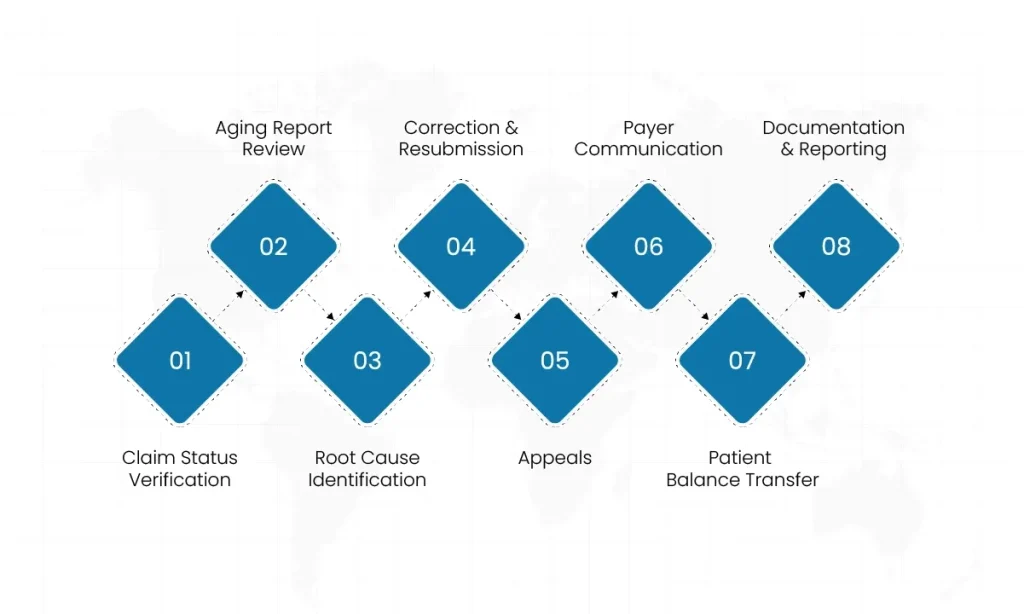
AR follow-up in medical billing is a multi-step process, which requires discipline and consistency. It involves the following steps:
1. Claim Status Verification
The first step is to verify the claim status with the insurance payer. This can be done via phone, payer portal, or a clearinghouse report. The verification is meant to provide the practice with whether the claim is:
- In process
- Paid
- Denied
- Rejected
The practice takes relevant actions based on the current status, aiming to resolve the pending claim if it is still unpaid.
2. Aging Report Review
Next, the billing team reviews outstanding claims based on their age. Ideally, claim recovery should be prioritized by approaching appeal or filing deadlines.
The billing team reviews claims by aging buckets (30, 60, 90, and 120+ days) to prioritize follow-up. This division helps determine:
- High-dollar accounts
- Underpayments
- Claims requiring immediate follow-up
3. Root Cause Identification
Once a claim is denied or rejected, the billing team identifies the underlying cause. Typically, denial or rejection reasons may include:
- Authorization gaps
- Missing documentation
- Non-adherence to payer-specific requirements
- Eligibility issues
- Coding errors
The team reviews the following information to determine the cause:
- Payer remittance advice (ERA/EOB)
- Denial reason codes
- Claim edits
- CARC/RARC codes
These steps distinguish each denial category, allowing the practice to take effective actions.
4. Correction and Resubmission
Claims that have correctable errors are rectified before being resubmitted under payer-specific rebilling rules. Some common corrections that may be made are updating:
- National Provider Identifier (NPI) information
- Patient demographics
- Diagnosis or procedure codes
- Place-of-service codes
- Insurance information
- Modifiers and units
5. Appeals
Claims denied for clinical or contractual reasons may require a formal appeal. For such claims, the staff prepares and provides documentation and submits an appeal within the insurance payer’s prescribed window.
6. Payer Communication
Payer communication is a vital step of AR follow-up in medical billing. During this step, the billing staff contacts the insurance payer for payments that are delayed without a valid justification. The aim is to request reprocessing or get a resolution timeline.
7. Patient Balance Transfer
After the payer adjudicates the claim, the remaining balance is billed to the patient through an itemized statement. The billing team will verify any:
- Applicable secondary insurance processing
- Coordination of benefits
- Deductibles
- Contractual adjustments
- Copayments
- Coinsurance
With this additional verification, the patient only pays for what is truly their responsibility.
8. Documentation and Reporting
Documentation is a vital part of the AR follow-up process for tracking and analyzing the trends related to submitted claims. The staff reports the following:
- Denial rates
- First pass claim acceptance
- Accounts receivable aging
- Days in A/R
- Appeal success rates
- Recovered amounts
- Payer-specific trends
These reports allow practices to identify bottlenecks, monitor staff performance, and improve revenue cycle efficiency.
Key AR Follow-Up Metrics to Track
The right KPIs let practices determine the underlying errors that should be prioritized. Once practices target the right errors, streamlining the follow-up process is simpler.
Days in AR
Days in AR is one of the most important KPIs for AR follow-up in medical billing. It measures the average number of days it takes a practice to collect payment after a claim is submitted. Thus, it is a core indicator of revenue cycle management (RCM).
Fewer AR days directly mean faster cash flow and reduced delays in collection. The days in AR should ideally be around 30-40 days. With the help of tracking AR days, practices can identify:
- Payer delays
- Billing bottlenecks
- Opportunities to improve claim submission and follow-up processes
AR Aging Buckets (0-30, 31-60, 61-90, 90+)
AR aging buckets indicate the receivables that have remained unpaid for long periods. A 0 to 30-day aging bucket is the ideal number per industry standards, but requires a smoother follow-up process. Practices with multiple unresolved denials directly increase the AR aging percentage.
Net/Adjusted Collection Rate (NCR)
The NCR calculates the ratio of collectible revenue after contractual adjustments. Or in other words:
(Total Payments / Total Charges) – (Contractual Adjustments / Total Charges)
The AAFP identifies NCR as a clear bad debt and loss of revenue. It may also indicate an untimely filing or other adjustments.
Practices with a high NCR rate indicate improved RCM and appropriate adjustment to contractual terms.
It may also indicate:
- Improved collection efficiency
- Accurate payment posting
- Minimal preventable revenue leakage
- Successful follow-up activities
Percentage of AR Over 90 or 120 Days
An increasing percentage of accounts receivable beyond 90 or 120 days may indicate that the appeals process requires improvement. The best way to optimize the existing system is by monitoring this metric based on the:
- Provider
- Specialty
- Payer
With the help of this segmentation, the practices can easily identify:
- Reimbursement delays
- Ineffective AR claims follow-up
- Unresolved denials
- Workflow bottlenecks, increasing collection risk
Denial Rate
The denial rate is typically calculated by dividing the number of denied claims by the total number of submitted claims.
According to AAFP standards, the average denial rate ranges between 5% and 10%. However, practices should aim for a denial rate of less than 5%.
First Pass Resolution Rate (FPRR)
The FPRR represents the number of claims that are accepted on the first submission, without requiring:
- Rework
- Resubmission
- Appeal
A practice with a high FPRR means its billing systems are efficient, reflecting strong performance in:
- Patient registration
- Insurance verification
- Medical coding
- Charge capture
- Documentation
- Claim editing processes
Some practices may not have the in-house expertise to manage AR KPIs effectively. In such cases, outsourcing AR follow-up to an experienced billing partner such as MediBillMD may be a practical solution. They offer:
- 98% clean claim rate
- 97% first pass ratio
- 96% net collection ratio
In-House vs. Outsourced AR Follow-Up
Understanding the difference between in-house and outsourced AR follow-up can be a game-changer for any practice.
Many times, practices overlook the gaps within their internal AR workflows, costing valuable claim reimbursements. The following table provides a comprehensive comparison of in-house and outsourced AR follow-up in medical billing.
| Factor | In-House AR Follow-Up | Outsourced AR Follow-Up |
|---|---|---|
| Staffing Cost | A fully trained and dedicated staff is required. | Labor costs are spent on a specialized billing partner. |
| Payer-specific Expertise | Limited to the internal teams’ prior experience. | Broader experience across different insurance payers and specialties. |
| Scalability | Harder to scale for higher claim volumes. | Can be scaled up or down, depending on the practice. |
| Oversight and Control | Real-time supervision and control with transparent status updates. | The billing partner should provide transparent reporting and regular performance updates. |
| Consistency | Staff turnover or absence can harm operations and slow down follow-ups. | Utilizes proper workflow structures, making the practice less dependent on individual staff. |
| Best Suited For | Smaller practices with lower claim submission volumes. | Practices with high Days in AR, staffing shortages, or complex payer portfolios. |
Our Verdict: Practices with persistent AR backlogs, staffing shortages, or complex denial workloads may benefit from outsourcing AR follow-up, while smaller practices with adequate internal resources may manage the process effectively in-house.
Common Challenges Practices Face with AR Follow-Up
Managing AR follow-ups can become challenging for practices, which can harm the revenue cycle. Most commonly encountered challenges may include the following:
Understaffing
Handling new claim submissions and follow-ups for older claims can thin out the billing staff, increasing the chance of aging claims being deprioritized.
Payer-Specific Rules
The timely-filing limits, documentation requirements, and appeal windows vary for each payer. Therefore, a one-size-fits-all approach does not work for practices.
The follow-up process may become ineffective unless the billing staff has customized workflows for each payer.
Manual Tracking Errors
Human error can result in huge losses for practices, which is why manual tracking isn’t the most optimal choice for claim management. Practices should move away from manual tracking because of fragmented spreadsheets.
Similarly, they should avoid disconnected systems that provide limited visibility into outstanding claims.
Slow-To-Pay Carriers
Payers can take longer periods to pay claims than a practice’s overall average days in AR. This can distort AR performance metrics unless the practice tracks payer performance separately.
High Initial Denial Volume Without Rework
Many claims are never reworked or resubmitted after they are rejected. Thus, practices leave significant recoverable revenue uncollected, distorting the revenue cycle.
Poor Documentation or Follow-up Actions
Documentation should ideally represent the actions taken. Without this record, the billing staff may:
- Miss deadlines
- Duplicate work
- Lose track of claim status entirely
Best Practices for Effective AR Claims Follow-Up
Practices that fail to address AR follow-up challenges often experience financial strain. Fortunately, the following best practices are highly effective in counteracting obstacles:
- Prioritize high-value claims and those approaching timely filing or appeal deadlines.
- Follow up on open claims according to payer turnaround times and organizational policies, typically every 10-15 days when appropriate.
- Review AR aging reports daily or weekly to identify claims approaching 90- or 120-day buckets.
- Contact the payer to verify claim status or determine whether corrections or resubmission are required before submitting another claim.
- Track denials by payer and denial reason to identify recurring billing issues and payer-specific trends.
- Separate contractual adjustments from noncontractual write-offs (such as timely filing or prior authorization errors) to identify process improvements.
Wrapping It Up
Effective AR follow-up in medical billing depends more on consistent processes than a single tactic. It demands consistency and proper billing workflows. Some effective strategies include:
- Working claims on a defined schedule
- Prioritizing by dollar value
- Tracking days in AR, denial rate, and aging buckets
Practices struggling with payer-specific requirements, aging claims, and appeal deadlines should consider additional support.
Partnering with an experienced medical billing partner can help improve first-pass resolution rates, reduce days in AR, and accelerate reimbursement.
Learn how MediBillMD’s AR recovery services strengthen AR follow-up workflows and improve your collections.