

Running a medical practice is one of the most challenging tasks because of the complex processes involved. Newer practices fail to understand how practical medical billing works.
This leaves the practices at a higher risk of making errors and facing claim denials. The result? Hiccups in medical billing collections for the practice.
The Medical Group Management Association (MGMA) reports that more than half of U.S. healthcare organizations experience a 10%+ denial rate.
Factors such as growing prior authorization burdens, inconsistent follow-up, and frequent payer edits all lead to uncollected insurance reimbursements. Such challenges with medical billing collections negatively impact the finances of any practice.
Thus, practices should understand how payment collection in medical billing works and how to reduce the gap between billed and collected revenue.
- Understanding Medical Billing Collections
- Insurance Collections vs. Patient Collections
- The Medical Billing Collections Process
- KPIs to Measure Medical Billing Collections
- Common Reasons for Poor Insurance Collections
- Best Practices to Improve Medical Billing Collections
- When to Outsource Medical Billing Collections?
Understanding Medical Billing Collections
Medical billing collections is the process of recovering payment for healthcare services after they are provided. Billing collections can be on two different fronts, i.e, patient collections and insurance collections.
Patient collections typically include:
- Deductibles
- Copays
- Self-pay balances owed directly by patients
Conversely, insurance collections involve pursuing reimbursement from payers such as:
- Commercial insurers
- Medicare
- Medicaid
Both of these collections are essential to any practice’s financial health. However, insurance collections are where most revenue may be at stake. Why? Most claims are submitted to the payer and not collected from the patient on the day of service.
Therefore, claim accuracy, effective denial management, and consistent payer follow-up directly affect the amount of reimbursement a practice ultimately receives.
Insurance Collections vs. Patient Collections
Providers often collect all the payments together. However, payer and patient collections usually have distinct timelines, different workflows, and require varying skill sets.
Insurance Collections
Insurance collections is a multi-step process that involves:
- Clean claim submission
- Claim status tracking
- Resolving denials and underpayments
- Aging accounts receivable (A/R) follow-up
This collection method requires eligibility verification, adherence to payer-specific claim guidelines, accurate coding, and timely appeals.
Patient Collections
Patient collections, on the other hand, are the balance amount after the insurance claim has been processed. Typically, patient collections include:
- Copays
- Coinsurance
- Deductibles
- Self-pay amounts
This side of medical billing collections depends on transparent patient statements, financial counselling, and flexible payment options.
The Medical Billing Collections Process
Medical billing collections involve multiple interconnected steps, making the process challenging without efficient workflows. An effective insurance collections workflow typically involves the following steps:
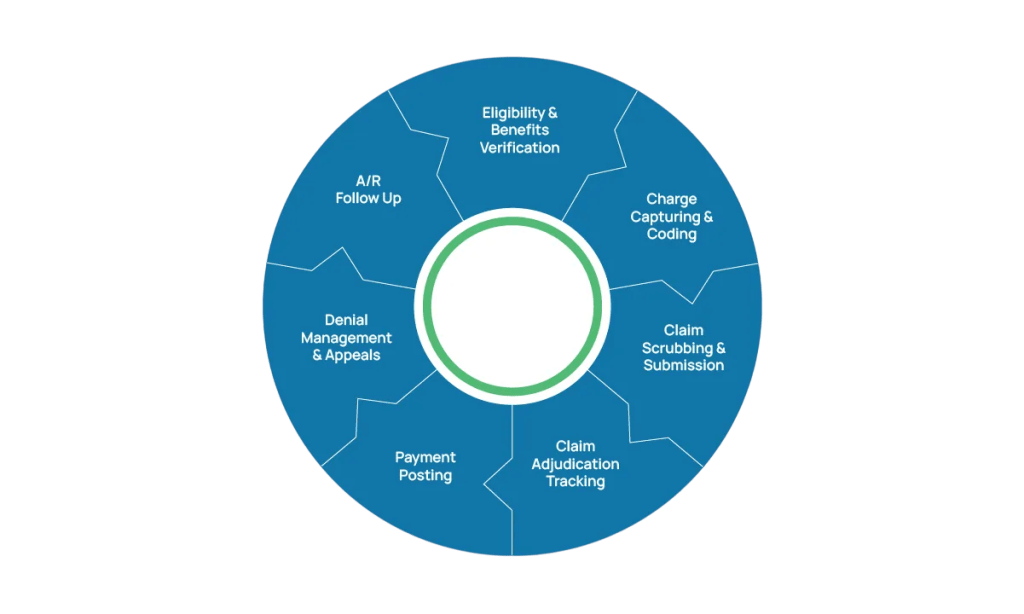
1. Eligibility and Benefits Verification
The first step is verifying the patient’s eligibility. If the patient is ineligible, they do not have medical coverage. Ideally, this should be done before services are rendered. The front-desk staff should review:
- Coverage status
- Health plan details
- Prior authorization requirements
2. Charge Capture and Coding
Once all the coverage prerequisites are verified, the performed services should be translated into accurate ICD-10, CPT, and HCPCS codes. Remember, incorrect charge capture can delay, underpay, or reject the claim.
3. Claim Scrubbing and Submission
Before claims are submitted to payers, they are scrubbed, i.e., validated for coding, demographic, payer, and billing errors. If everything is accurate, they are submitted to the correct payer electronically.
4. Claim Adjudication Tracking
After submission, the billing team monitors claim status, including payer receipt, acceptance, claim adjudication, and payment progress.
5. Payment Posting
All the payments and adjustments against the correct claim line items are posted to the patient’s account in this step.
6. Denial Management and Appeals
If the submitted claim includes errors, it may be denied. Therefore, during denial management and appeals, the reason for the denial is identified before resubmitting or appealing within deadlines specified by the payer.
7. A/R Follow-Up
If everything else is complete, the billing team systematically works on aging claims. The team follows up on unpaid or underpaid claims based on aging reports, often categorized into 30-, 60-, and 90-day aging buckets.
Important Billing Note: Each stage of the insurance collections process builds the next. Thus, missing eligibility verification can lead to claim rejections, denials, payment delays, and ultimately increased accounts receivable.
KPIs to Measure Medical Billing Collections
Key performance indicators (KPIs) specific to medical billing collections give insight into any practice’s current billing system. They help identify underlying issues and potential bottlenecks that may be harming the practice’s finances.
Unfortunately, nascent practices may overlook these KPIs, which later result in costly claim delays or denials. Here is a comprehensive breakdown of the benchmarks billing teams should follow:
Net Collection Rate (NCR)
The NCR calculates the percentage of the allowed reimbursement, which is the amount a practice actually collects.
According to benchmarks for practices, a healthy NCR should be at 95% or higher. If a practice has a high NCR, it directly translates to strong revenue cycle performance. Additionally, it indicates:
- Underpayments or avoidable write-offs
- Effective follow-up
- Minimal revenue loss
- Accurate payment posting
Gross Collection Rate (GCR)
GCR is the comparison of total payments received and the total charges billed. Typically, it is less accurate than NCR because it does not account for contractual adjustments. However, GCR provides a broad view of collections.
The GCR can be reviewed with NCR to assess the financial performance of any practice. This ensures the practice has a clearer idea of its existing medical billing collections and makes necessary adjustments if required.
Days in A/R
Days in A/R measures the average number of days it takes to collect payment after a claim is submitted. Practices should keep this under 40 days, as fewer A/R days reflect a healthy and smooth revenue cycle.
First Pass Resolution Rate (FPRR)
Claim denials and delays are a leading cause of disruption in medical billing collections. FPRR measures the percentage of claims that are fully adjudicated and paid on the initial submission without requiring correction, appeal, or resubmission.
A practice with a high FPRR rate generally ensures:
- Thorough eligibility verification
- Proper charge capture
- Minimal billing errors
- Complete documentation
- Compliance with payer guidelines & other benchmarks
Denial Rate
The denial rate is the percentage of claims denied by the payer. Ideally, practices should strive to keep their initial claim denial rate below 5%, although acceptable benchmarks vary. Once the practice identifies denial trends, it may indicate:
- Authorization deficiencies
- Coding inaccuracies
- Eligibility issues
- Documentation gaps
- Non-compliance risks
Clean Claim Rate
The clean claim rate represents the claims submitted without manual correction before the payer accepts them. While FPRR focuses on the financial outcome of claims, the clean claim rate focuses on pre-submission accuracy.
Nonetheless, a higher clean claim rate generally reflects stronger front-end billing processes and contributes to more efficient insurance collections.
For instance, MediBillMD’s clean claim rate performance is above the billing averages. That is a good example of how a practice’s billing processes should look for seamless insurance collections.
To achieve this goal, billing teams should:
- Track KPIs monthly
- Compare against payer-specific practices
- Investigate any drop immediately
Common Reasons for Poor Insurance Collections
Many issues related to insurance collections originate during the billing process. If a practice fails to address these issues, insurance reimbursements and overall medical billing collections may decline.
A payer that overlooks these triggers will see their revenue plummet. Most commonly, collections may get tanked because of the following:
Claim Denials
MGMA Stat polling identifies claim denials and appeals as major contributors to revenue cycle leakage.
Practices must identify the root cause of denials and fix them before they become a pattern. Generally, denials are attributed to coding, front-end, and billing issues.
Coding Errors
Medical coding can be complex, which is why it is a cause of frequent claim denials. For instance, the billing team submits an incorrect or mismatched diagnosis or procedure code, and the payer rejects it.
Eligibility Verification Failures
If a claim is submitted for a patient whose coverage has lapsed or been updated, it will trigger a denial.
Late Claim Filings
If a billing team misses the payer’s claim submission deadline, the claim is forfeited entirely, regardless of medical necessity.
Insufficient Documentation
Clinical justification is a key driver for smooth reimbursements. However, if the claims were submitted without supporting documentation justifying the procedures’ or services’ medical necessity, they will be denied or delayed.
Lack of Follow-Up on Unpaid Claim
If a claim stays in A/R without follow-up, the chances of collection drop. Claims that remain unresolved for extended periods leave valuable medical billing collections behind.
Therefore, billing teams should analyze the unpaid claims and perform regular follow-ups to get the reimbursements they deserve.
Best Practices to Improve Medical Billing Collections
Medical billing collections are a necessary part of any practice’s revenue. However, when collections are stalled, the practice may suffer serious financial consequences. It has a direct impact on the operations, sustainability, and performance of the practice.
Therefore, practices should learn the most effective tactics to improve medical billing collections. Here is what we recommend:
Always Verify Eligibility Upfront
Eligibility verification is the first step of a smooth reimbursement process before every patient visit. Ideally, front-desk staff should confirm that the patient has active coverage before services are rendered.
This helps confirm that the patient’s insurance coverage is active and that the planned services are eligible for reimbursement. Moreover, the practice can also determine the deductible and copayment responsibilities of the patient and discuss them with the patient.
Additionally, the eligibility verification detects changes in insurance plans. Thus, professionals should not rely on previous visits, as denials are also caused by:
- Terminated coverage
- Incorrect member information
- Plan changes
Submit Clean Claims the First Time
Clean claims are imperative for smooth medical billing collections. A clean claim includes complete and accurate information, such as:
- Demographics
- Insurance information
- Diagnosis
- Procedure codes
- Modifiers
- Provider identifiers
- Supporting documentation
However, practices may need to employ routine coding audits to detect errors before submission. This is the simplest way to increase the FPRR alongside accurate documentation.
Avoid Delaying Denial Management
Denial management is a part of medical practice management. However, leaving denials unattended or unresolved can be costly. Practices should proactively pursue such claims, but with a strategy.
Denials shouldn’t be treated as an isolated incident. Instead, practitioners should identify potential denial patterns.
We suggest segmenting the denials by the following categories to avoid losing medical billing collections:
- Service line
- Denial reason
- Payer
- Provider
Organizations can implement corrective actions much more smoothly and prevent future denials.
Build Payer-Specific Follow-Up Workflows
Claim submission rules, documentation requirements, appeal deadlines, and reimbursement policies are unique for each payer. Therefore, practices should have dedicated follow-up methods so that escalated claims are rectified efficiently.
Monitor KPIs Regularly
Your KPIs are the foundation of smooth medical billing collection. The following KPIs should be assessed each month:
- Days in A/R
- Net Collection Rate
- Denial Rate
Practices can use these KPIs to identify performance issues and make operational improvements before revenue is affected.
Prioritize Prior Authorization Tracking
Many practices now dedicate staff and technology to manage prior authorization as authorization-related issues are a common cause of claim denials. They are also adding structured tracking tools to avoid authorization-related denials before claims submission.
When to Outsource Medical Billing Collections?
Managing medical billing collections in-house can quickly become a liability for any practice, especially when:
- A/R ages past 60-90 days
- Billing staff turnover is high
- The team lacks payer-specific expertise
Such circumstances are warning signs that could compromise your operations in the long run. Thus, it’s crucial to take the necessary steps promptly.
Specialized billing partners, like MediBillMD, can help. They assist you with:
- Denial reduction
- Clean claim rate improvement
- Reimbursement acceleration
Practices should outsource medical billing to them for improved insurance collections.