

Did you know that hierarchical condition category (HCC) coding relies on ICD-10-CM codes to assign risk scores to patients? But what exactly is HCC?
For the unversed, it is a risk adjustment model designed to estimate future health care costs for patients. The Centers for Medicare and Medicaid (CMS) initiated it in 2004.
This guide will break down everything you need to know about it, from the most common HCC categories to its importance and key challenges. So, continue reading!
HCC Categories in Risk Adjustment Coding
The hierarchical condition categories (HCCs) are the fundamental building blocks of the CMS-HCC risk adjustment coding model.
From over 70,000 ICD-10-CM codes, HCC maps over 7,770 codes into 115 categories in V28. The previous V24 had 9,797 ICD-10 codes with 86 categories. These categories group conditions that represent similar clinical complexity and expected cost.
So, what does the hierarchical rule state? When a patient has multiple related codes within a specific family, CMS only pays for the most severe hierarchical condition to prevent redundant reimbursement.
Covering all 115 categories in this guide is nearly impossible. However, we have compiled a list of the most common HCC categories documented by healthcare providers nationwide:
| HCC Code | Description |
|---|---|
| HCC 18 | Diabetes with chronic complications. |
| HCC 19 | Diabetes without chronic complications. |
| HCC 40 | Rheumatoid arthritis and inflammatory connective tissue disease. |
| HCC 58 | Major depressive, bipolar, and paranoid disorders. |
| HCC 72 | Spinal cord disorders or injuries. |
| HCC 80 | Coma, brain compression, or anoxic damage. |
| HCC 86 | Acute myocardial infarction. |
| HCC 106 | Atherosclerosis of the extremities with ulceration or gangrene. |
| HCC 114 | Aspiration and specified bacterial pneumonias. |
| HCC 136 | Chronic kidney disease, stage 5. |
| HCC 169 | Vertebral fractures without spinal cord injury. |
| HCC 189 | Amputation status, lower limb, or amputation complications. |
Example of Risk Adjustment Scoring
Picture a female patient who is 68 years old and has type 2 diabetes without complications, hypertension, and a body mass index (BMI) of 38.2:
| ICD-10-CM Code | Description | Risk Adjustment Factor (RAF) |
|---|---|---|
| Demographics, i.e., gender and age. | 0.323 | |
| E11.9 | Type 2 diabetes mellitus without complications. | 0.105 |
| I10 | Essential (primary) hypertension. | 0.000 |
| Z68.38 | BMI 38.0-38.9, adult. | 0.000 |
| Total Risk | 0.428 |
Importance of Risk Adjustment Coding
The following are some of the benefits of hierarchical condition category coding:
Ensures Fair Reimbursement
With risk adjustment coding, healthcare providers receive higher payments for patients who require more medical care. For example, a 71-year-old patient with multiple sclerosis and diabetes costs more than a healthy 21-year-old.
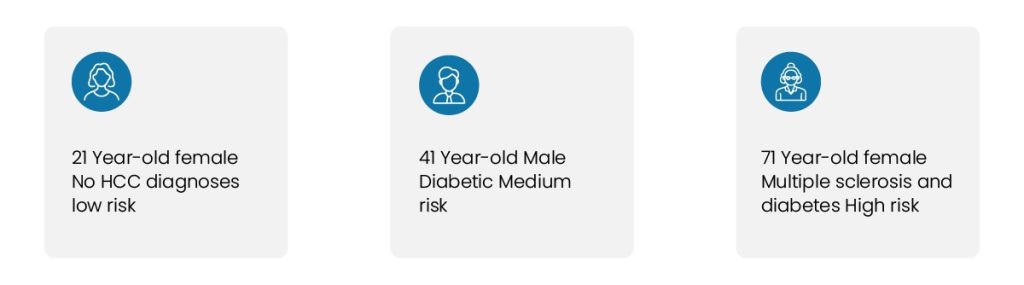
Besides, when you accurately code patient symptoms and conditions, it helps health systems avoid significant deficits when treating high-acuity populations.
Enhanced Care Management & Data Integrity
Note that risk adjustment or HCC coding is not a mere financial tool; it is a clinical roadmap. With it, healthcare organizations can identify patients requiring intensive case management or home-based interventions.
Additionally, it plays an integral role in closing care gaps. That is, it enables providers to discover undertreated and undocumented chronic conditions. This ultimately results in improved clinical outcomes and proactive care management.
Guarantees Compliance
HCC coding directly impacts federal payments. As a result, it is under constant scrutiny by organizations such as CMS and the Office of Inspector General (OIG).
Thus, error-free coding is your only defence against audit risks and recoupment.
Seamless Transition to Value-Based Care
The U.S. healthcare system’s transition from volume to value-based care is in full swing.
But, where does the HCC coding fit into all this? It communicates a patient’s health status and future risk to payers. This helps insurance carriers determine the future payments for every patient based on their complexity and disease risk.
What’s more? Innovative healthcare programs, like Primary Care First’s success, also depend on accurate risk adjustment coding.
Challenges in HCC Coding
Let’s review some of the key challenges associated with hierarchical condition category coding:
The MEAT Documentation Requirement
Detailed and specific documentation is key to preventing audit risks or payment clawbacks. It demands that the physician support the HCC coding by recording the MEAT in documentation.
To keep everyone on the same page, here’s what the MEAT entails:
- Monitor signs, symptoms, and disease progression/regression.
- Evaluate test results and the patient’s response to treatment.
- Assess counseling, ordered tests, and medical records.
- Treating medications, therapies, procedures.
The Issue? Healthcare providers treat the patient but forget to document specific MEAT elements. The outcome? It makes the HCC code invalid for risk adjustment.
The Annual HCC Coding Reset
Another challenge that physicians face is that the HCC codes do not carry forward automatically from one calendar year to the next. That is, you must document and submit the chronic condition in a face-to-face encounter at least once every year.
The issue? There may be a scenario where you fail to capture the code for a patient with a permanent disability or chronic condition, like chronic obstructive pulmonary disease (COPD). When this happens, the health plan loses funding for the patient for the entire year until the HCC code is resubmitted.
Unspecified Codes & Zero-Risk Adjustment
Coding specificity is a key requirement of HCC coding. But the ICD-10-CM code set is extensive, and many codes require high levels of specificity. For example, diabetes with stage 3 chronic kidney disease.
The Issue? Physicians often use unspecified codes either out of habit or due to time constraints. The outcome? Zero risk adjustment weight, which means you will be reimbursed at the base rate.
RADV Audits & Regulatory Complexity
OIG and CMS conduct risk adjustment data validation (RADV) audits. These audits help them ensure that the risk-adjusted payments made to health insurance plans are accurate.
The issue? The coding and billing rules are constantly shifting. Keeping up with these changes manually is challenging for small practices.
Partner With MediBillMD
With that said, it is time to conclude! Ensuring accurate HCC coding is essential to ensure you receive rightful reimbursements against your rendered care services. However, it becomes an administrative burden given the extensive ICD-10-CM code set. Thus, if you require professional help, feel free to outsource medical coding services to MediBillMD. We have a team of certified professional coders (CPCs) ready to assist you.