
Did you know that on average, 41% of healthcare providers face claim denial rates of at least 10%?
Even though you can resolve most denials by submitting a reworked claim or an appeal letter, things are not as simple as they seem. The reason? It costs you, on average, $25 per claim for practices and $181 per claim for hospitals.
Yes, the price to appeal the denial decision is high. Thus, you should choose your battles wisely.
This guide will discuss everything you need to know to limit the denial rate to a minimum. So, continue reading!
What are Claim Denials in Medical Billing?
In medical billing, a denial occurs when you send a medical bill (known as a medical claim) for your rendered care services to a payer for payment, but they refuse to reimburse it.
How does it differ from claim rejection? A rejection happens due to formatting errors even before the insurance carrier processes the claim. Contrarily, a claim denial is a formal decision made after the payer has adjudicated or reviewed the claim.
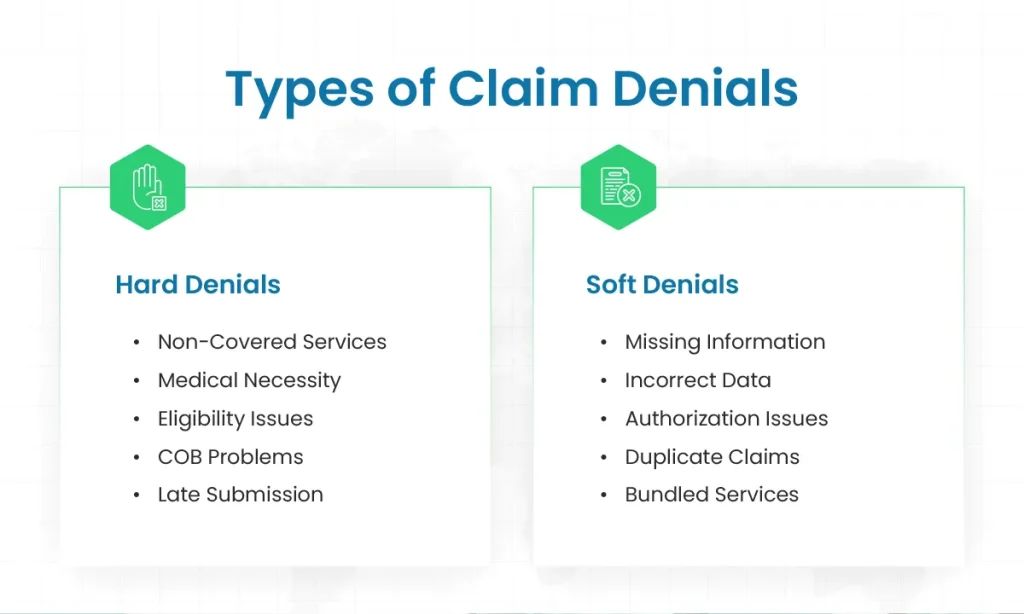
For context, there are two main types of denials, i.e., hard denials and soft denials. Soft denials are temporary and can be easily resolved with corrective actions. On the other hand, hard denials are permanent. That is, you cannot reverse hard denial decisions made by the payer, resulting in lost revenue.
Claim Denial Management & Prevention Best Practices
Before we start discussing the best practices, it is integral to understand the difference between claim denial management and denial prevention.
Yes, you may have seen people use these two terminologies interchangeably. However, they require completely different operational mindsets.
Difference Between Claim Denial Prevention & Management
The table below offers an at-a-glance view of the key differences between denial management and denial prevention:
| Denial Prevention | Denial Management | |
|---|---|---|
| What approach does it utilize? | It uses a proactive approach. That is, prevention occurs before the claim is submitted to the payer. | It uses a reactive approach. That is, denial management takes place after the payer rejects a medical claim. |
| What is the goal here? | To eliminate the root causes of errors and enhance the claim first-pass rate. | To recover lost revenue by appealing or correcting errors. |
| What does it involve? | It includes activities such as eligibility verification, obtaining prior authorizations, and claim scrubbing. | It involves CARC codes tracking, writing appeal letters, and resubmission of corrected claims. |
| How does it impact the cost? | Automated front-end checks save hours of back-end labor, i.e., low impact on cost. | It requires significant labor and time to rework a single claim denial, i.e., high impact on cost. |
| How can you measure its success? | Its success metric is clean claim rate and first-pass ratio. That is, the percentage of claims paid on the first submission. | Its success metric is the recovery rate. That is, the percentage of denied dollars you eventually collect. |
Best Practices for Denial Prevention (The Front-End Approach)
Here are some of the effective strategies for denial prevention:
Proactive Eligibility Verification
One way to avoid claim denials is to perform real-time patient eligibility verification. This involves confirming their active status, insurance coverage, and coordination of benefits (COB) before the encounter happens.
Pre-Authorization Tracking
Many insurance carriers, including federal programs (Medicare, Medicaid) and commercial payers, require you to obtain prior authorization. It is a primary requirement for certain high-cost care procedures.
Submitting a claim for these services without a pre-authorization number results in an automatic denial. However, you can prevent this revenue leakage due to claim denials by obtaining prior authorization before rendering the services.
Ensure Documentation Completeness
No claim is paid by the payer (federal or private) if the service is deemed medically unnecessary.
Thus, you should strive for documentation completeness and accuracy. The reason? It serves as evidence that the rendered service was necessary to treat a patient’s condition.
Besides, try to be as specific as possible to ensure accurate reimbursements and prevent claim denials.
Leverage Claim Scrubbing Tools
Coding accuracy is another claim denial prevention best practice you should implement. Undoubtedly, the CPT and ICD-10 code sets are extensive, making the code selection complicated.
The solution? Utilize an automated claim scrubber to check for correct coding initiative (CCI) edits and missing modifiers before submission.
Best Practices for Denial Management (The Back-End Approach)
Discussed below are some of the proven denial management strategies you can implement:
Stick to the 72-Hour Rule
You should implement the 72-hour rule across your billing team. It is a gold standard in claim denial management.
Simply put, you should correct and resubmit the reworked claim within 48 to 72 hours. If you take any longer than this, your accounts receivable will start to bleed. That is, cash flow slows down, and the administrative burden increases.
Group Denials By Reason Code
Try to categorize claim denials as per the claim adjustment reason codes (CARC). But, how does it work?
If 30% of your denials are code CO-16, which indicates missing or incorrect information, it highlights a front-end registration problem. The outcome? You can use this insight to strengthen your front-end billing workflow to prevent future denials.
Utilize Appeal Templates
Standardizing the appeal templates is another best practice to speed up the claim denial management process. How?
Create a library of clinical appeal letters for common denials, such as experimental treatment, medical necessity, etc. This will save you time and effort.
Outsourcing – A Strategic Claim Denial Prevention Tool
Outsourcing denial management services not only helps you recover the lost revenue but can also help you prevent future denials.
Your in-house staff is often too overwhelmed with daily administrative tasks that it becomes challenging to perform a thorough denial analysis. However, outsourcing to a professional can be a game-changer.
Let’s review a few benefits of outsourcing:
Access to Specialty-Specific Expertise
Note that professional medical billing companies, like MediBillMD, hire only certified professional coders (CPCs).
The benefit? You get access to billing specialists and coding experts who stay current on complex updates, such as the transition from V24 to V28 HCC coding. This ultimately reduces the likelihood of coding-related claim denials.
Advanced Denial Analysis
Professional medical billing companies leverage proprietary software to identify denials across thousands of medical claims.
The outcome? You acquire insightful data to streamline your billing workflow and prevent future claim denials.
Reduced Overhead Cost
When you outsource claim denial management, you do not have to hire or train in-house resources. Besides, you save big on leasing a place, equipment, and proprietary software. As a result, your overhead costs are reduced.
Partner With MediBillMD & Recover Lost Revenue
With that said, it is time to conclude!
A claim denial in medical billing is the payer’s decision to refuse reimbursement against a medical claim. The good news is, you can prevent and resolve most denials by implementing the effective strategies we have discussed throughout this guide.
However, if you are short on staff and lack the necessary denial management expertise, it is best that you outsource denial management to professionals, like MediBillMD.